
While we like to stay away from the word *should*, the real question is – how does executive equity change as a company raises capital?
This week, we’re continuing our deep dive to answer your frequently asked compensation questions. Using the comp planning tool from the Thelander Platform, (a hybrid of our dataset and consulting resources, now off the shelf), we’re looking at how equity changes for a CEO as they raise capital.
So, how does it change?
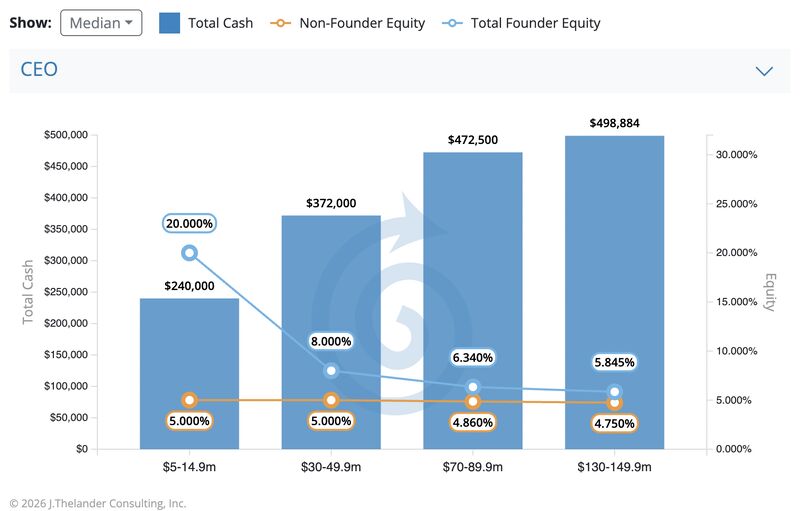
- Generally speaking, as a company raises more capital, total cash increases and equity decreases.
- At the median, the CEO founder total equity starts at 20.00% for companies that have raised between $5 – $14.9 million (equivalent of a Seed), and gets diluted down to 8.00% ($30 – $49.9M, equivalent of Series A), then 6.34% ($70 – $89.9M, Series B) and 5.84% ($130 – $149.9M, Series C).
That’s a ~70% reduction in the founder CEOs equity stake. - For a non-founder CEO, the median equity starts at 5.00% for $5 – $14.9 million (Seed) and stays steady until the $70 million mark (Series B) where it decreases to 4.86% and then lands at 4.50% (Series C)
What does this mean for you and your team? How do you plan ahead?
If you’re a CEO raising capital here are two things you need to know when it comes to you and your team’s compensation.
- Benchmark before you raise, not after.
Regardless of how busy you are, make sure you understand how your current compensation compares to market benchmarks – especially ahead of raising more capital. This way, you’re armed with data, not feelings, so you are working from a factual basis of what market is paying and where you stand. It also gives you the perspective you need to know how your equity (and cash!) will evolve as your company grows. - Plan for dilution across your team, not just for yourself.
Know who your key people are, and make sure their compensation is competitive too. Especially if you can’t afford to lose them.
This is where a salary structure with total cash & equity ranges becomes critical, along with thoughtful planning around your option pool. This way you’re prepared for today, and what’s coming next.
To see how your current companies’ compensation compares to market, complete the private company compensation survey today. You’ll be able to view 25th, median, 75th and maximum percentiles for all comp levers – including founder and non-founder equity.