
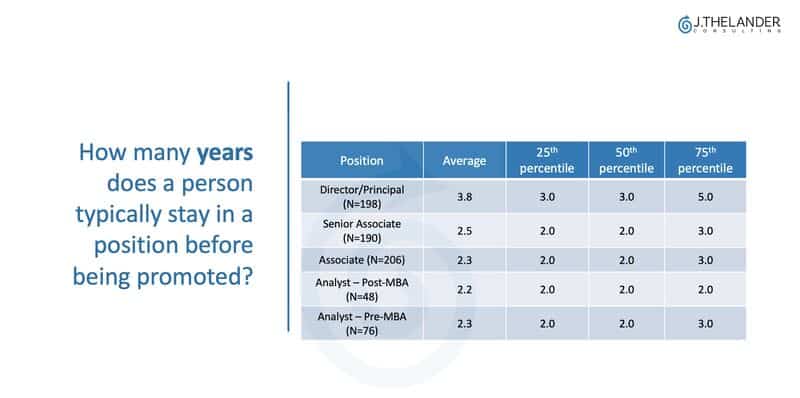
The promotion timeline at investment firms varies by level, but the data reveals a clear pattern: the higher you climb, the longer it takes to move up. Using data from the Thelander platform across 500+ investment firms, here’s how long professionals typically spend in each role before their next promotion. Using data from the Thelander platform from 500+ investment firms:
- Analysts (pre- and post-MBA) move up in about 2 years.
Both pre-MBA and post-MBA analysts move up in roughly two years on average (2.3 and 2.2 years, respectively). At this early stage, progression is relatively quick and consistent—the median time in role is 2 years, with the top quartile moving on within 3.
- Associates and Senior Associates typically spend 2-3 years before the next step
Associates spend about 2.3 years in role on average, and Senior Associates 2.5 years. The pace is similar to the analyst level, but the range widens slightly at the top: while the median holds at 2 years, a quarter of professionals at these levels spend 3 or more years before advancing.
- Director/Principal? Expect 3-5 years before the next promotion
This is where progression slows meaningfully. Directors and Principals spend 3.8 years in role on average—the longest of any level—with the median at 3 years and the 75th percentile stretching to 5. The step up from this level is the most significant, and the data reflects the longer runway it takes to get there.
The Pattern: Promotions Slow as You Climb
Across the board, the trend is consistent: roughly 2 years per promotion early in a career, stretching to nearly 4 at the Director/Principal level. For professionals mapping their trajectory—and firms structuring their advancement paths—understanding these benchmarks is the first step.
Wondering how your compensation should progress as you move up the ladder? Complander helps individuals benchmark current—and future—compensation at investment firms and private companies.