Independent board members bring industry expertise and valuable networks to the table — and attracting the right ones means knowing what the market pays. So, how does private company non-investor board member compensation actually work? Is it a mix of cash and equity? According to Thelander, yes. And does it change as companies grow? Again, yes. Significantly.
What the Data Is Actually Saying
The overall picture:
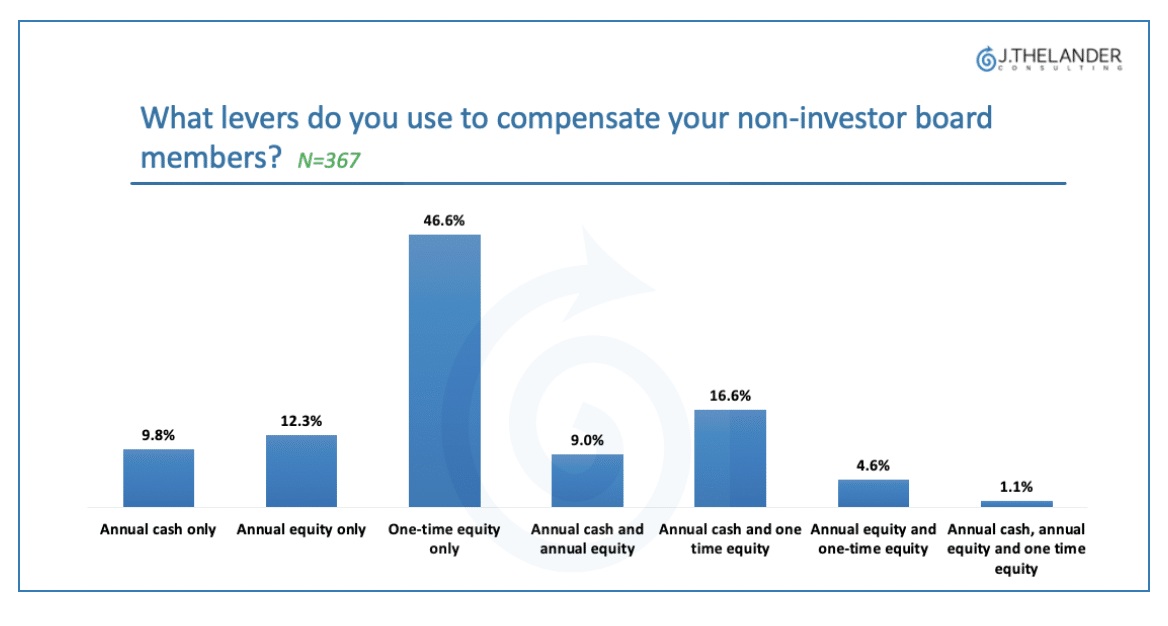
- One time equity dominates at 46.6% – nearly half of all private companies surveyed use it as their sole compensation lever.
- Annual cash and one-time equity combined is the second most common at 16.6% , followed by annual equity only at 12.3%.
The financing stage story is where it gets really interesting:
- Early stage (under $15M raised) – One-time equity is king at 56%, and almost nobody uses cash.
- Mid stage ($15 – $49.9M) – One-time equity drops to 48% and cash starts appearing more.
- Later stage ($50 – $89.9M) – One-time equity continues dropping to 43%, and annual cash + one-time equity jumps to 15%.
- Most mature ($90M+) – The biggest shift. One-time equity collapses to 31%, and annual cash + one-time equity rises to 26%.
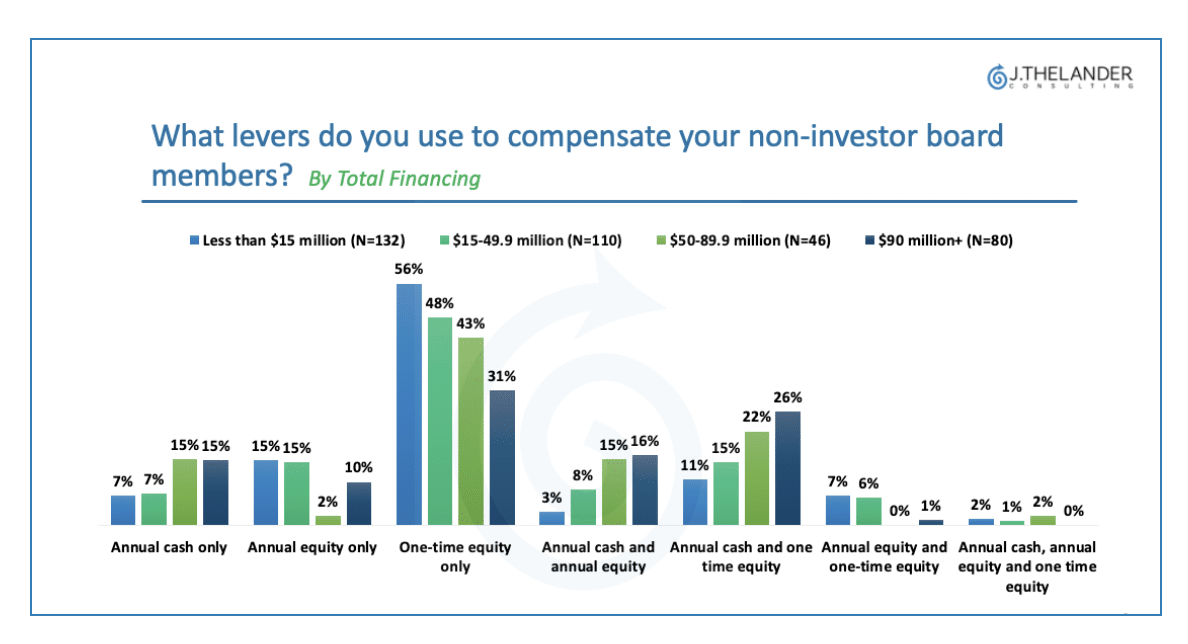
The through line: As companies raise more capital, they shift from pure one-time equity toward cash and equity combinations. The board formalizes compensation in lock-step with the company.
The full non-investor board compensation report is available on the Thelander platform. If you are a current subscriber, you can download it by logging in here. Interested in becoming a subscriber, or purchasing the report as a standalone? Request a demo here.
Thelander offers discounted pricing and bundles to early-stage companies.