
Through our consulting work, we’ve seen that more investment firms are interested in Shadow/Phantom/Synthetic (SPS) carry programs. This involves setting aside a portion of returns, whether from the managing partner’s carry or the overall GP share, and distributing it as a bonus. It is another vehicle to incentivize junior employees while retaining more flexibility and discretion than traditional carry.
At CVC Units, SPS is used more frequently, with a concentration at the more senior roles. At venture capital firms, it’s the opposite.
So let’s look at what CVC units are doing, since they are the SPS carry OGs.
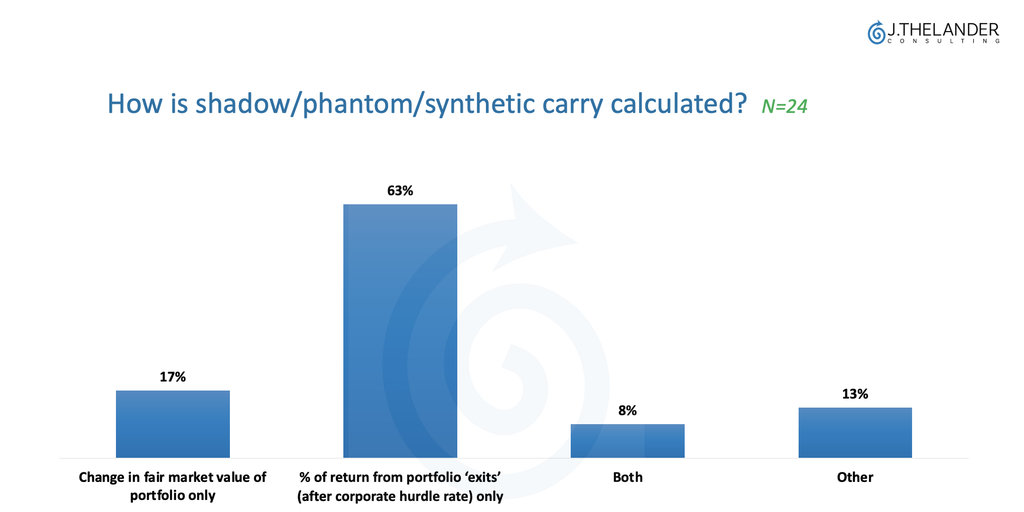
SPS carry tends to be calculated as a percentage of returns from portfolio exits, although 25% of units use change in fair market value or a combination of the two.
That’s great. But how is it paid?
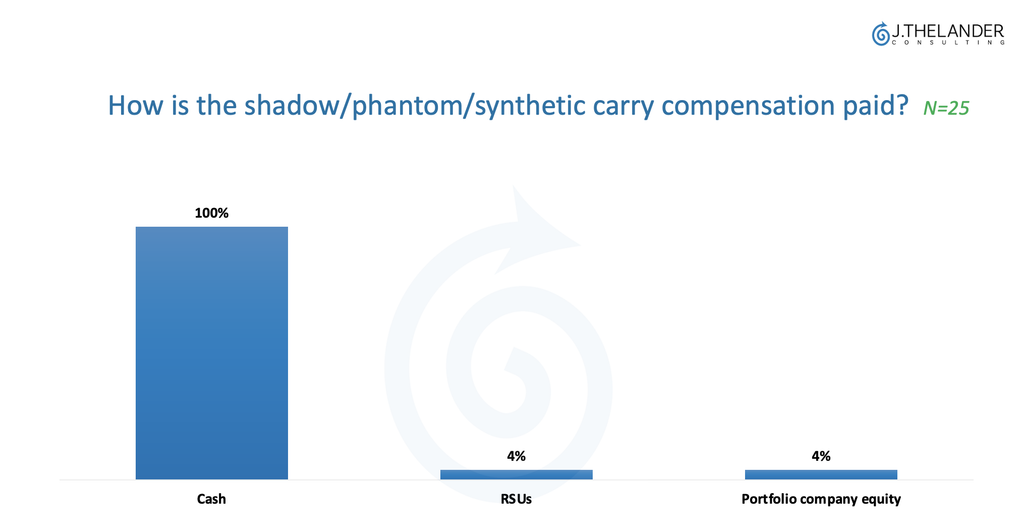
- SPS carry is generally paid in cash, sometimes with RSUs or portfolio company equity as an add-on.
- Because it’s paid in cash, SPS carry is typically taxed as ordinary income rather than capital gains, a meaningful difference from traditional carried interest.
Let’s look at the cash value of SPS carry for the two most prominent investment roles at CVC Units – CVC Unit Leaders and Senior Investment Professional I’s. Hint: it’s highly differentiated.
- For CVC Unit Leaders, the median cash value of the SPS carry distribution is $565,000, increasing to $2.05 million at the 75th percentile, with a maximum of $10 million.
- For Senior Investment Professional I’s, the median is $300,000, increasing to $1.65 million at the 75th percentile, with a maximum of $3 million.
The spread is significant. For CVC Unit Leaders, the 75th percentile is more than 3.5x the median, while the maximum is nearly 18x the median.
For Senior Investment Professional I’s, the 75th percentile is 5.5x the median, and the maximum is 10x the median.
This is likely a result of the highly differentiated functions of CVC Units in terms of not just size but also their places within the corporate structures of their parent companies. As well as different ways SPS carry is calculated, with some units using deal-based methods of calculation and others using fund-based ones.
The bottom line: Some CVC Units have modeled their compensation after VC firms. Now, there are some venture firms reversing the flow by borrowing from the CVC playbook. Why? Because SPS carry gives firms another way to reward junior talent with compensation tied to fund performance without using traditional carry.
Thelander works with all types of investment firms to design their plans. If you’d like to learn more, respond to this email and we’ll be in touch. You can also complete the compensation survey and unlock real-time cash and carry data for all the job titles you fill out for no charge.